

Note
Go to the end to download the full example code.
The Kitaev Chain: Majorana Zero Modes#
A. Kitaev (2001) wrote down the simplest topological superconductor: a chain of spinless fermions with nearest-neighbour hopping \(t\) and p-wave pairing \(\Delta\),
In the Bogoliubov-de Gennes form its bulk spectrum is \(E(k) = \pm\sqrt{(2t\cos k - \mu)^2 + 4|\Delta|^2\sin^2k}\), gapped except at \(|\mu| = 2|t|\). For \(|\mu| < 2|t|\) the chain is topological: an open chain hosts one Majorana zero mode at each end – a fermion split in two halves, a building block proposed for topological quantum computation, and chased in semiconductor nanowires since 2012. Kitaev’s own bulk invariant is the Majorana number
the signs of the Pfaffians of the Hamiltonian written in Majorana operators at the two time-reversal-invariant momenta: \(-1\) in the topological phase, \(+1\) otherwise. It needs only particle-hole symmetry (class D). With the extra chiral symmetry of this real chain (class BDI), the Berry (Zak) phase of the occupied BdG band, \(\pi\) or 0, says the same.
tbkit.bdg builds the chain in real space (bdg_ham) and in
reciprocal space (bdg_kspace).
import numpy as np
import matplotlib.pyplot as plt

import tbkit.lattices as lattices
from tbkit.bdg import bdg_ham, bdg_kspace, majorana_number, pairing_bonds, particle_hole
from tbkit.kspace import KSpace
from tbkit.plot import Plot
from tbkit.system import System

t, delta = 1., 0.6


def kitaev(mu):
    chain = KSpace(lattices.chain())
    chain.set_hopping([{'i': 0, 'j': 0, 'R': (1,), 't': t}])
    return bdg_kspace(chain, [{'i': 0, 'j': 0, 'R': (1,), 'delta': delta}], mu=mu)
The lattice#
A chain of spinless fermions, one site per cell. Each nearest-neighbour bond carries both the hopping \(t\) and the p-wave pairing \(\Delta\), which binds fermions on neighbouring sites.

The bulk spectrum and the invariant#
for mu in (0.5, 1.5, 3.):
    for k in (0.4, 1.3, 2.7):
        e = np.sqrt((2*t*np.cos(k) - mu)**2 + 4*delta**2*np.sin(k)**2)
        assert np.allclose(np.linalg.eigvalsh(kitaev(mu).get_ham([k])), [-e, e])
assert kitaev(0.5).symmetry_error(particle_hole(1), antiunitary=True, anti=True) < 1e-12
print('Class:', kitaev(0.5).tenfold_class(time_reversal=np.eye(2), particle_hole=particle_hole(1)))

mus = np.linspace(-3.5, 3.5, 29)
zak = np.array([abs(kitaev(mu).berry_phase(0, nk=200)) for mu in mus])
topological = np.abs(mus) < 2 * abs(t)
assert np.allclose(zak[topological], np.pi) and np.allclose(zak[~topological], 0., atol=1e-8)
print('Berry phase pi for |mu| < 2|t|, 0 outside.')
# at |mu| = 2|t| the gap closes at k = 0 or pi, and the Majorana number is undefined
gapped = ~np.isclose(np.abs(mus), 2 * abs(t))
majorana = np.array([majorana_number(kitaev(mu)) for mu in mus[gapped]])
assert np.all(majorana[topological[gapped]] == -1) and np.all(majorana[~topological[gapped]] == 1)
try:
    majorana_number(kitaev(2 * t))
    raise AssertionError('the gap closes at k = 0')
except ValueError:
    pass
print('Majorana number -1 for |mu| < 2|t|, +1 outside.')
Class: BDI
Berry phase pi for |mu| < 2|t|, 0 outside.
Majorana number -1 for |mu| < 2|t|, +1 outside.
Majorana zero modes at the ends of an open chain#
n = 40
lat = lattices.chain()
lat.get_lattice(n)
sys = System(lat)
sys.set_hopping([{'n': 1, 't': t}])
sys.get_ham()
spectra = {}
for mu in (0.5, 3.):
    en, vec = np.linalg.eigh(bdg_ham(sys.ham, pairing_bonds(sys, delta), mu=mu).toarray())
    spectra[mu] = en
    assert np.allclose(en, -en[::-1])  # particle-hole symmetric
zero = np.argsort(np.abs(spectra[0.5]))[:2]
print('mu = 0.5: two states at |E| = {:.1e}; next at {:.3f}.'
          .format(np.max(np.abs(spectra[0.5][zero])), np.sort(np.abs(spectra[0.5]))[2]))
assert np.max(np.abs(spectra[0.5][zero])) < 1e-8 and np.min(np.abs(spectra[3.])) > 0.5
# the zero modes live at the ends (particle and hole components summed)
en, vec = np.linalg.eigh(bdg_ham(sys.ham, pairing_bonds(sys, delta), mu=0.5).toarray())
weight = np.abs(vec[:n, zero]) ** 2 + np.abs(vec[n:, zero]) ** 2
ends = weight[:5].sum() + weight[-5:].sum()
print('Weight of the two zero modes on the outer 5 sites of each end: {:.0%}.'.format(ends / 2))
assert ends / 2 > 0.95
# and the same chain from the Bloch model
assert np.allclose(spectra[0.5], np.linalg.eigvalsh(kitaev(0.5).finite_ham(n)))

fig, axes = plt.subplots(1, 2, figsize=(10, 4))
axes[0].plot(mus, zak / np.pi, 'o-b', label=r'Berry phase / $\pi$')
axes[0].plot(mus[gapped], majorana, 's--r', ms=4, label=r'Majorana number $\mathcal{M}$')
axes[0].set_xlabel(r'$\mu/t$')
axes[0].legend()
axes[1].plot(np.arange(n), weight.sum(axis=1), 'o-r')
axes[1].set_xlabel('site')
axes[1].set_ylabel('zero-mode weight')
axes[1].set_title(r'Majorana end modes, $\mu = 0.5t$')
fig.set_layout_engine('tight')
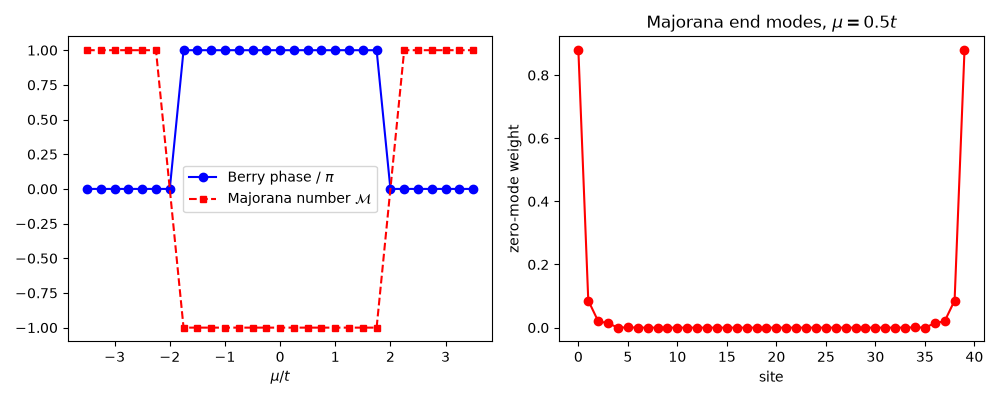
mu = 0.5: two states at |E| = 1.2e-12; next at 1.145.
Weight of the two zero modes on the outer 5 sites of each end: 100%.
Total running time of the script: (0 minutes 0.099 seconds)