Tight-Binding#
The generic real-space and reciprocal-space machinery: the square
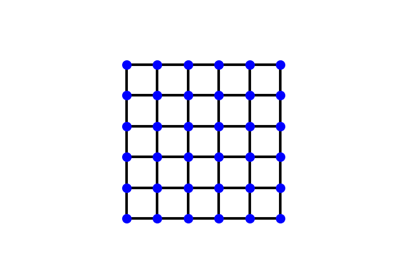
lattice, whose single band is simple enough to check by hand, as the
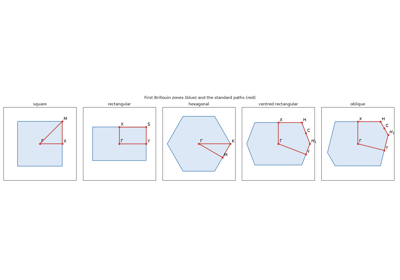
smallest complete illustration of Bloch’s theorem; Brillouin zones and
the standard high-symmetry paths of the 2D and 3D Bravais lattices;
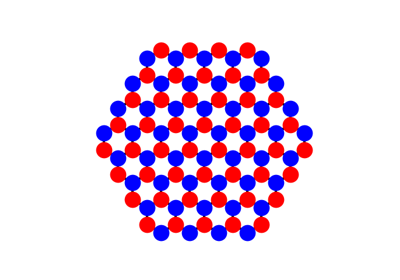
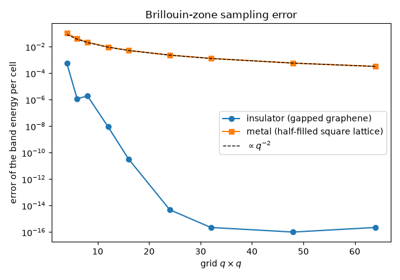
Monkhorst-Pack k-point grids; a graphene flake
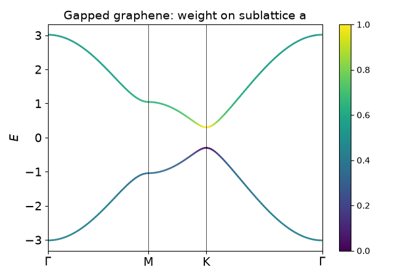
diagonalized directly and its Bloch band structure along a k-path,
including Wallace’s 1947 linear (Dirac) dispersion near the K point;
the physics behind the 2004 isolation of graphene – flakes, edge
states, and the Berry phase of pi of its Dirac cones; the zigzag edge
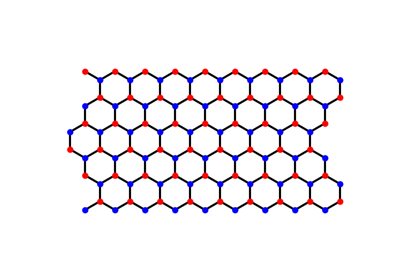
states of graphene ribbons and the 3m + 2 rule of armchair ribbons;
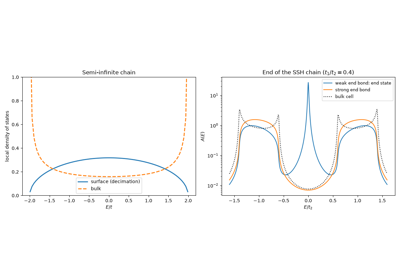
surface Green’s functions by Lopez Sancho decimation; and
tbkit.plot.Plot’s lattice, spectrum, density-of-states, and
eigenstate-intensity plots; parametrized Hamiltonians, whose value
functions let a flux or dimerization sweep re-evaluate the hoppings
instead of rebuilding the model; periodic boundaries in real space,
tori and cylinders whose spectra match the Bloch bands on a k-mesh;
and the analysis of a band structure: Fermi surfaces and their Lifshitz
transitions, bands projected on sublattices or spins and spin textures,
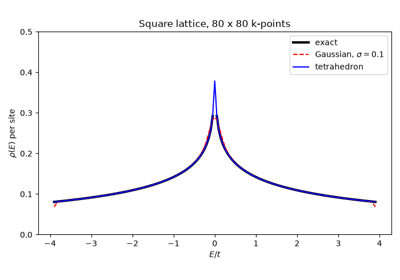
and the tetrahedron method for the density of states.
Building Finite Lattices: Unit Cells, Cuts, and Lattice Arithmetic
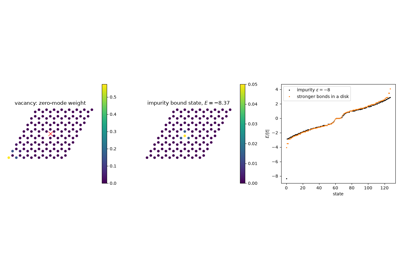
Defects and Impurities in a Graphene Flake: Vacancy Zero Modes and Bound States
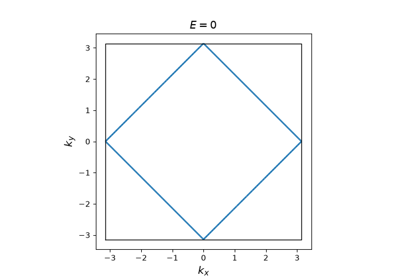
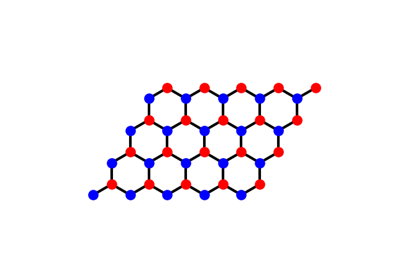
Graphene: Real-Space Flake and Reciprocal-Space Bands
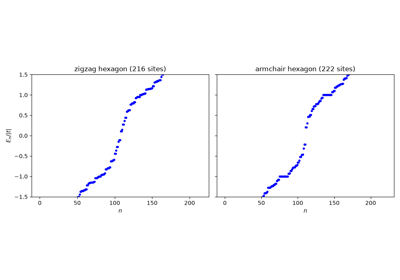
The Isolation of Graphene: Flakes, Edges, and a Berry Phase of pi
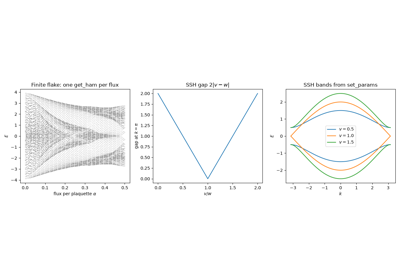
Parametrized Hamiltonians: Sweeping Without Rebuilding
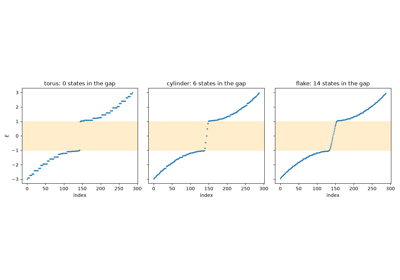
Periodic Boundaries in Real Space: Tori and Cylinders
The Square Lattice: Bloch’s Theorem in its Simplest Form
The Surface Green’s Function by Lopez Sancho Decimation